
Read After Print And 2D Codes Combined For The First Time
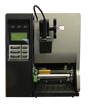
As is widely known, the simplest way to ensure proper product marking, is the technology named “Read after Print”. With this technology, the linear barcode can be tested for readability, by means of a scanner, directly after label printing.
The company Barcodat GmbH (authorized reseller of TSC) who specialises in automatic data collection systems, has for the first time succeeded in using 2D codes combined with the brand-new industrial printer series TTP-2410M Pro by TSC Auto ID, ensuring they work both impeccably and reliably.
"This step was necessary, particularly because in highly industrialised production lines such as those in the automotive and electronic industry, faulty labels can have disastrous consequences”, says Uwe Renn, who manages the Barcodat Corporate Communications Department, “because products and product components are tagged with 2D codes increasingly frequently, i.e. DataMatrix is predominant due to its high information content”.
The experts from Dornstetten, Germany, previously used to run this technique on the powerful thermal transfer printer of the TTP-2410M Pro series. During the label printout, a stationary Area Imager on the printer’s front side reads the barcode without any manual intervention. When the barcode is inaccurate, the system automatically shuts down, and optical as well as acoustic warning signals can be programmed. After verification and elimination of the cause of failure, the system can be rebooted.
And why is this printer model especially advantageous for the above-mentioned application? Dieter Oster, printing expert with Barcodat, explains: “The already integrated software is completely compatible with the used scanner, making it easier to program the whole system.” Power supply and data transfer take place via the printer’s RS-232C interface, which can also be used for stand-alone operations thanks to the (optional) USB host.
The standard functions of the high performance printer, which is based on the successful platform of the TSC bestseller - TTP-2410M - and supports thermal transfer ribbons up to a length of 600 metres, include serial and parallel interfaces as well as integrated Ethernet and a 32 bit RISC processor and offers storage capacities of 8 MB FLASH and 32 MB SDRAM.
First customers are enthusiastic, because they can now also benefit, without restrictions, from the advantageous test method that has been successfully used with the linear barcode as well as with two-dimensional codes. The advantages are: reduction of the error quota with label printing, enhanced process security and savings in label material, thermal transfer ribbons and time.
However, there is one restriction. According to barcode expert Uwe Renn, the Read-after-Print method has remained purely a performance check and does not include a quality check of the barcode. Those customers, who need to verify either the main parameters of their barcodes or the ISO 15416 standards for linear codes and the ISO 15415 for 2D codes, need a barcode verifier or experienced specialist from Barcodat who not only supply such devices, but also offer a barcode verification service to the respective standards.
Source: TSC Auto ID Technology Co., Ltd